

Most BigCommerce reviews either read like a rewritten pricing page or skip straight past the platform’s biggest 2026 change entirely — a new transaction fee that quietly shifts the real cost of running a store here. This review covers both: what BigCommerce actually does well, and exactly what changed this year that every merchant evaluating the platform needs to understand before signing up.
Short version: BigCommerce remains one of the strongest choices for mid-market and B2B-focused stores, but the June 2026 pricing overhaul means the sticker price alone no longer tells the full story.
BigCommerce is a fully hosted ecommerce platform that handles web hosting, server maintenance, and security infrastructure on the merchant’s behalf, letting store owners focus on running their business rather than managing technical operations. Since its founding, it’s grown to power over 137,000 online businesses worldwide, positioning itself specifically as a platform built for growth — every plan, including the entry tier, includes unlimited products, unlimited bandwidth, and unlimited staff accounts, a genuinely generous baseline compared to competitors that often gate these basics behind higher-priced tiers.
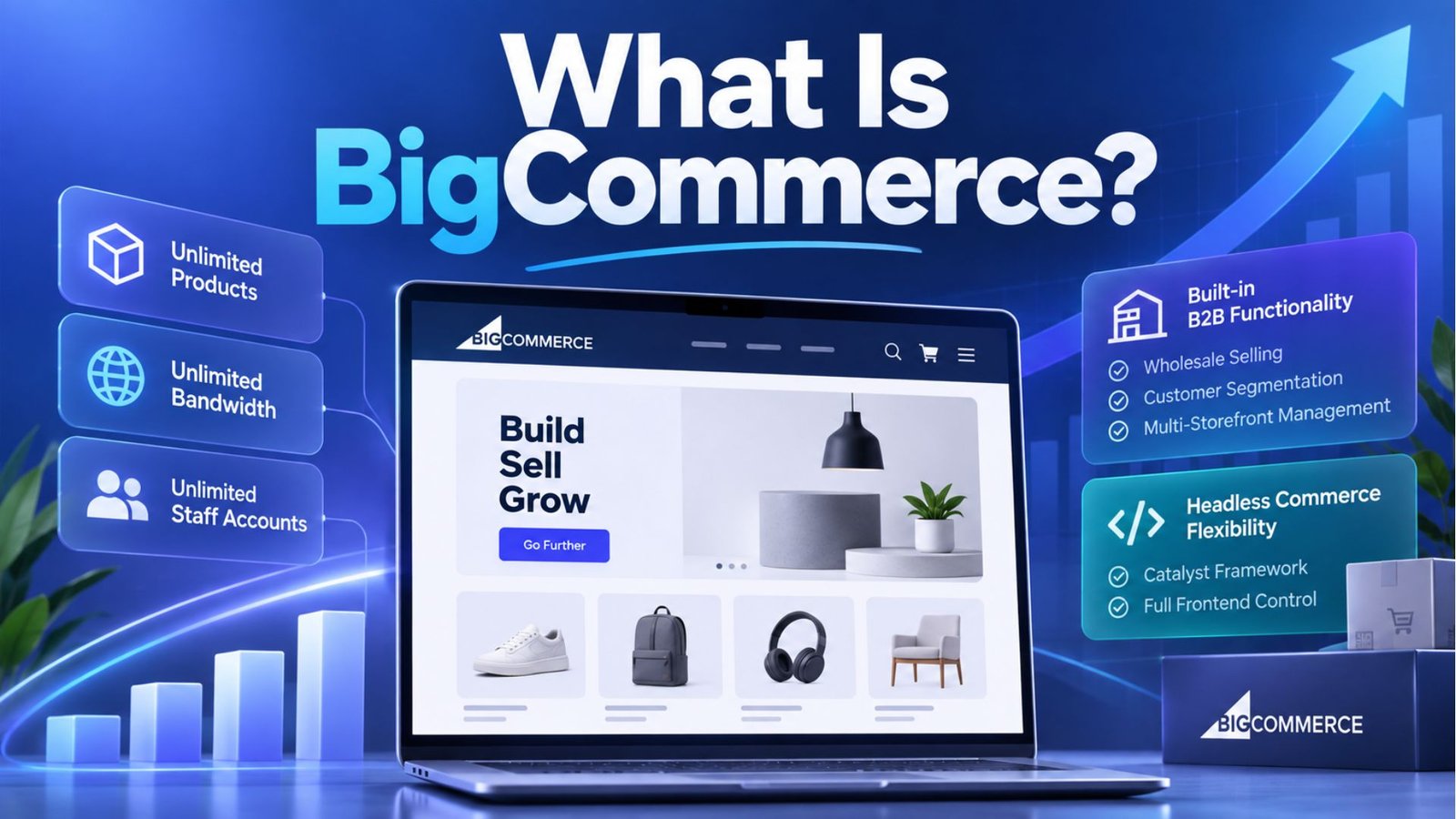
What sets BigCommerce apart from more consumer-focused platforms is where its strength concentrates: built-in B2B functionality and headless commerce flexibility. Rather than treating wholesale selling, customer segmentation, and multi-storefront management as premium add-ons requiring enterprise-tier pricing, BigCommerce builds much of this directly into its standard plan structure. Its Catalyst framework, a modern headless storefront architecture, gives development teams a genuinely credible alternative to Shopify’s Hydrogen framework for businesses that want full control over their frontend while keeping BigCommerce’s backend commerce engine. This combination — B2B depth without an enterprise price tag, plus real headless flexibility for technical teams — is exactly why BigCommerce consistently attracts mid-market businesses in the roughly $500,000 to $5 million annual revenue range, a segment where Shopify’s simplicity starts feeling limiting but full enterprise platforms feel like overkill.
Understanding BigCommerce pricing in 2026 requires walking through a genuinely significant structural change that took effect in June. The platform renamed its entire plan lineup — Standard became Core, Plus became Growth, Pro became Scale, and Enterprise became Performance — while simultaneously adjusting the revenue caps tied to each tier and introducing a new fee structure that catches a lot of merchants off guard if they’re comparing old pricing information found in outdated articles.
Core starts at $29/month on annual billing ($39/month paid monthly), covering stores under roughly $30,000-$50,000 in trailing twelve-month sales, and includes unlimited products, staff, and bandwidth along with reviews and a blog built in, though notably without abandoned cart recovery. Growth runs $79/month annually ($105 monthly), covering up to $100,000 in trailing revenue and unlocking customer segmentation, abandoned cart recovery, persistent cart, and 24/7 phone support that Core lacks. Scale costs $299/month annually ($399 monthly), extending coverage further and adding advanced product filtering, custom SSL certificate installation, and Google Customer Reviews integration. Performance, the renamed Enterprise tier, uses custom pricing typically starting around $1,000/month, built for stores exceeding roughly $400,000 in annual sales or requiring deep B2B functionality and dedicated account management.
The genuinely new piece for 2026 is the Open Payment Provider Fee: if you process payments through a gateway that isn’t on BigCommerce’s approved Embedded Payment Providers list, you’ll now pay an additional 2% fee on Core, 1% on Growth, or 0.6% on Scale. This single change meaningfully shifts total cost of ownership for merchants who’ve built their payment stack around a specific non-approved processor for other business reasons, and it’s a detail worth confirming directly with BigCommerce before assuming your current setup avoids the fee. One more structural quirk carries over from previous years: exceeding your plan’s revenue cap triggers an automatic upgrade to the next tier, which is worth planning for financially rather than being surprised by mid-growth.
For larger operations, BigCommerce enterprise features — now under the Performance plan name — include unlimited API calls, custom price lists for B2B customers, priority support with dedicated account management, and access to ShipperHQ’s advanced shipping rules engine. These features specifically target businesses with complex, high-volume operations where the standard plan tiers’ built-in tools aren’t sufficient, and custom pricing reflects that scale rather than following a fixed public rate card.
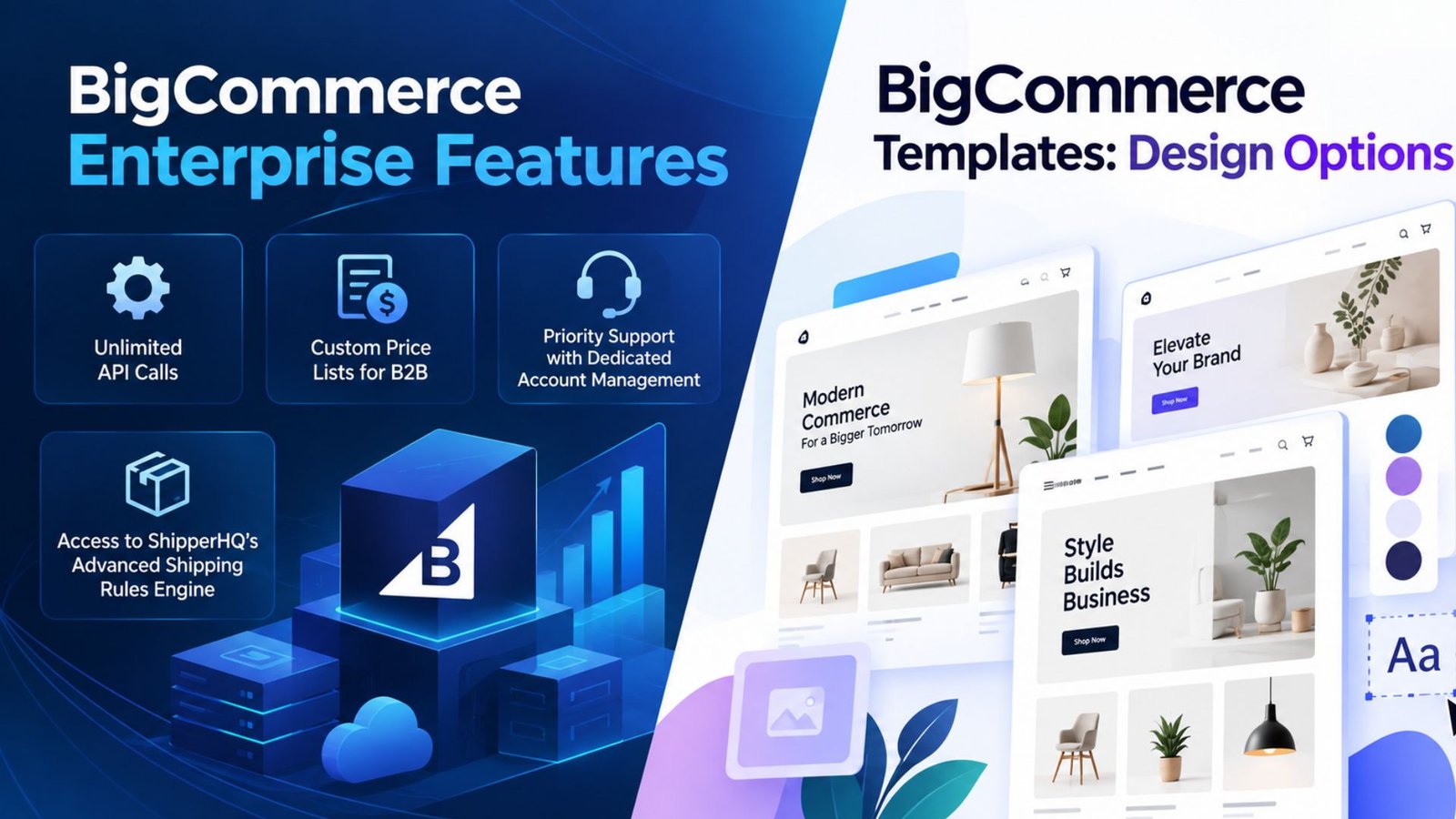
BigCommerce templates cover a solid range of professionally designed themes across the platform’s marketplace, with both free and premium options available. The built-in drag-and-drop Page Builder handles most day-to-day storefront customization without needing code, though achieving a truly custom design beyond what the theme system offers typically requires developer involvement — a limitation worth knowing upfront if brand-specific design is a top priority for your launch.
Accessing your store starts with the standard BigCommerce login portal, where merchants sign into their store’s admin dashboard to manage products, orders, and settings. New users go through account verification during signup, after which the login credentials grant access to the full control panel — the central hub for every aspect of running the store day to day.
BigCommerce integration options span payment gateways, accounting software, email marketing platforms, and ERP systems, connected either through native integrations or the app marketplace. While the integration ecosystem is genuinely solid for mainstream tools, it’s smaller in raw volume than Shopify’s app marketplace, which occasionally means a specific niche integration requires custom development work rather than an off-the-shelf app.
A frequently searched concern, BigCommerce SEO capability, is actually one of the platform’s understated strengths. Every plan includes customizable URL structures, meta tags, and canonical URL controls out of the box — tools that some competitors lock behind apps or higher tiers. Combined with fast, reliable hosting performance (a real ranking factor), BigCommerce gives merchants a solid technical foundation for organic search without needing extensive third-party SEO tooling just to reach baseline optimization.
The BigCommerce marketplace offers a curated selection of apps covering marketing, shipping, accounting, and customer service functionality. It’s a more limited catalog than some competitors offer, which is the tradeoff for a marketplace that leans toward higher-quality, more thoroughly vetted listings rather than sheer volume — worth weighing depending on how heavily your specific store relies on niche, specialized app functionality.
For stores needing customization beyond the built-in tools, working with a BigCommerce development agency becomes a common next step, particularly for headless storefronts built on the Catalyst framework or complex B2B configurations. Agencies experienced specifically with BigCommerce’s architecture can implement custom functionality, migrate existing stores, and optimize performance in ways that go well beyond what an in-house team without ecommerce development experience could reasonably handle alone.
Beyond full agencies, BigCommerce experts — independent consultants and BigCommerce-certified partners — offer a lighter-weight option for stores needing focused help with a specific task: a migration, a design overhaul, or an integration setup, without committing to an ongoing agency retainer. BigCommerce’s own partner directory is a reasonable starting point for vetting experience level before committing to any specific consultant.
As one of several major BigCommerce ecommerce platforms competitors, the honest comparison usually comes down to Shopify versus BigCommerce for most merchants. Shopify wins on simplicity and app ecosystem size; BigCommerce wins on built-in B2B depth, multi-storefront management, and headless flexibility without needing Shopify Plus’s enterprise pricing to access comparable capability. Neither is universally better — the right choice depends heavily on whether your business needs B2B functionality and technical customization, or values the simplest possible setup experience above all else.
What works well:
Where it falls short:
Across current BigCommerce reviews, the consistent theme is clear: it remains one of the strongest platforms available for mid-market and B2B-focused merchants, offering genuine built-in functionality that competitors often charge enterprise prices to match. The 2026 pricing restructuring — new plan names, adjusted revenue caps, and the new payment provider fee — is a real shift worth understanding before committing, but it doesn’t change the platform’s core strength. For a growing business that needs more than a basic storefront, BigCommerce remains a smart, well-positioned choice heading into 2026.
BigCommerce is a fully hosted ecommerce platform built with stronger native B2B and multi-storefront functionality than most competitors offer at comparable price points, while Shopify generally wins on simplicity and app ecosystem size.
Plans are tied to your trailing twelve-month revenue, starting at $29/month annually for Core. A new Open Payment Provider Fee (2% on Core, 1% on Growth, 0.6% on Scale) now applies if you use a payment gateway outside BigCommerce’s approved list.
Every plan includes customizable URLs, meta tags, and canonical URL controls by default, giving most stores a solid SEO foundation without needing extensive third-party tooling.
Once customization needs go beyond the built-in Page Builder — a headless Catalyst storefront, complex B2B configuration, or custom integrations — working with an agency or certified expert typically saves significant time and avoids costly implementation mistakes.