
If you’ve spent any time reading a Salesforce Review or researching customer relationship management software, you’ve probably noticed one name comes up over and over again: Salesforce. That’s not hyperbole or marketing fluff. Salesforce has earned its place as the world’s leading CRM platform through decades of innovation, a vast ecosystem of tools, and a track record that spans from startups to Fortune 500 behemoths. But what actually makes it stand out from the dozens of other CRM options on the market today?
In this article, we’ll break down exactly why Salesforce is the best CRM for businesses of nearly every size, walk through how does Salesforce work, cover the honest pros and cons of Salesforce, and help you decide why use Salesforce over a competitor. We’ll also touch on what goes into implementing Salesforce CRM and when bringing in managed services Salesforce providers makes sense.
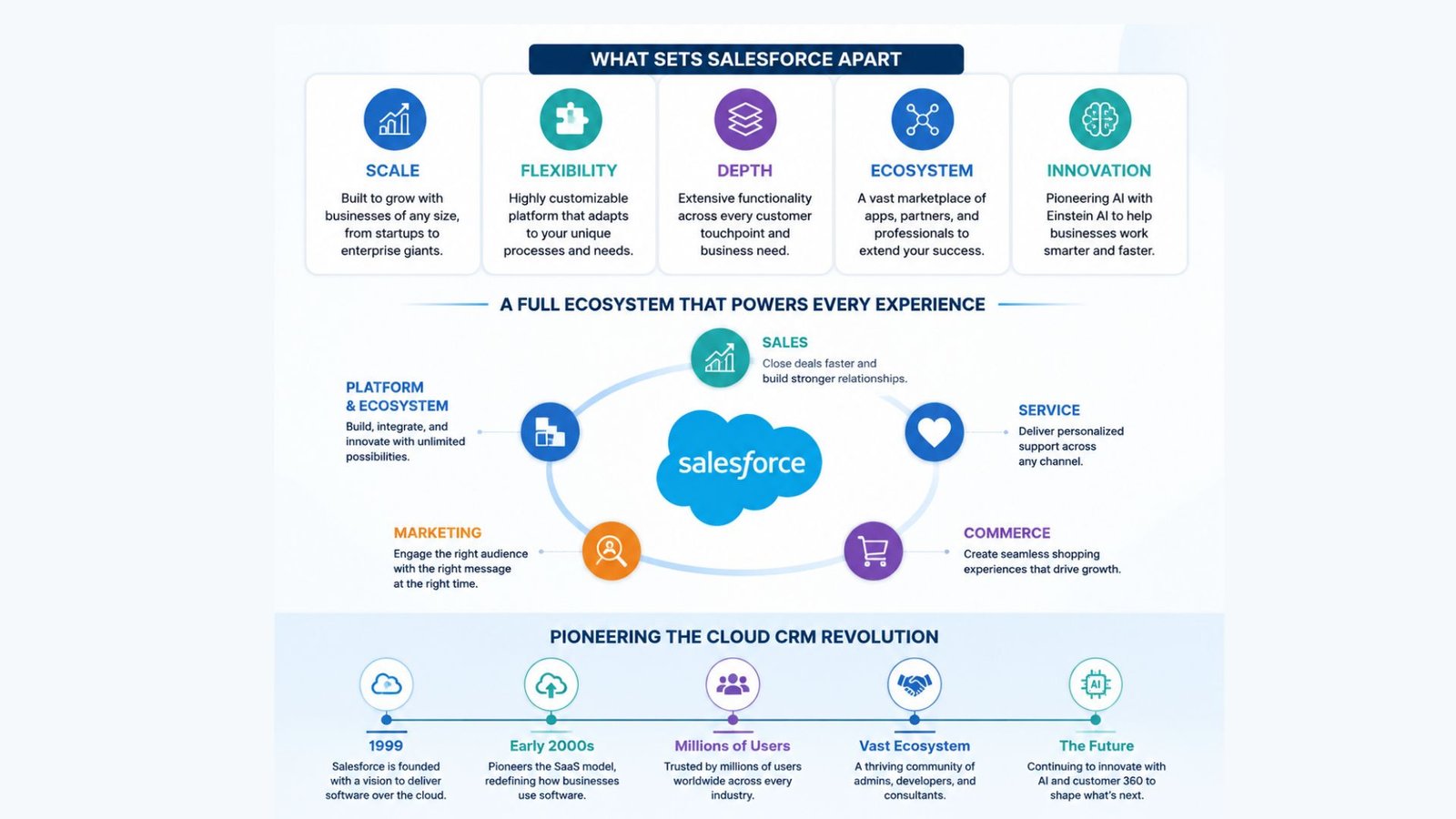
At its core, a CRM exists to do one thing: help businesses manage relationships with customers and prospects in an organized, trackable way. Plenty of platforms can do that on a basic level. What separates Salesforce is scale, flexibility, and depth. Salesforce isn’t just a contact database with a nice interface — it’s a full ecosystem that touches sales, marketing, customer service, commerce, and now, increasingly, artificial intelligence.
Founded in 1999, Salesforce pioneered the idea of delivering software entirely through the cloud, long before “SaaS” was a household term. That head start gave the company nearly two and a half decades to refine its product, absorb feedback from millions of users, and build an ecosystem so large that entire careers — Salesforce administrators, developers, consultants — now revolve around the platform alone.
Understanding how Salesforce works starts with comprehending its basic structure. At the core of the platform is the customer database – all your contacts, accounts, leads and opportunities are stored here and connected in such a way that sales, marketing and service teams all see one single view of each relationship.
From there, Salesforce is built around ‘clouds’, which work almost like modules or departments within the platform:
Each of these clouds pulls from the same underlying data, which means a sales rep, a support agent, and a marketing manager can all be looking at the same customer record — just through a lens tailored to their job. On top of that, Salesforce has layered in Data Cloud, which unifies data from outside sources like website behavior and support history into a single customer profile, and Agentforce, its suite of autonomous AI agents that can qualify leads, route support cases, and even draft customer communications without a human clicking a single button.
Automation is where Salesforce really shines operationally. Using a visual, largely no-code tool called Flow, businesses can build workflows that automatically update records, send notifications, or trigger follow-up tasks based on real customer behavior — no developer required for most use cases.
Out of the box, Salesforce works well. But its real power shows up when you start customizing it. Businesses can create custom fields, objects, and entire applications tailored to their exact workflow — something most off-the-shelf CRMs simply can’t match. A real estate firm, a healthcare provider, and a manufacturing company can all run on Salesforce, each configured completely differently, because the platform was designed to bend to the business rather than force the business to bend to it.
Salesforce has a marketplace called AppExchange with thousands of pre-built apps and integrations for everything from accounting software, to document signing, to industry-specific tools. Instead of building every feature from scratch, companies can just plug in a solution that has already been tried and tested by thousands of other companies. This ecosystem is a huge reason to adopt Salesforce over a smaller, more closed platform.
A five-person startup and a ten-thousand-employee enterprise can both run on Salesforce — the platform simply scales with the business. This matters enormously for growing companies that don’t want to migrate to an entirely new CRM every time they hit a growth milestone. Switching CRM platforms is disruptive and expensive, so choosing one that can grow alongside you from day one saves real time and money down the road.
Salesforce’s Agentforce platform, which has been greatly expanded through 2026, is a real change in what CRM software can do. Rather than just suggesting the next best action for a human to take, Agentforce agents can independently qualify leads, resolve routine support cases, and update records — all grounded in real customer data pulled from Data Cloud. Businesses deploying these agents have reported meaningful reductions in response times and a real drop in manual busywork for their teams. Competing platforms are racing to catch up, but Salesforce’s head start in AI-driven automation is difficult to overstate.
Teams can monitor pipeline health, predict revenue, and analyze campaign results with inbuilt dashboards and reporting tools, without exporting data to a separate analytics program. For sales and marketing leaders, having real-time visibility into what’s working — and what’s not — is often the one single biggest factor in hitting quarterly targets.
The dominant CRM for so long, Salesforce has an enormous talent pool of certified administrators, developers, and consultants available to help implement, customize, and maintain it. That’s a real advantage versus niche CRMs where finding experienced help can be a challenge.
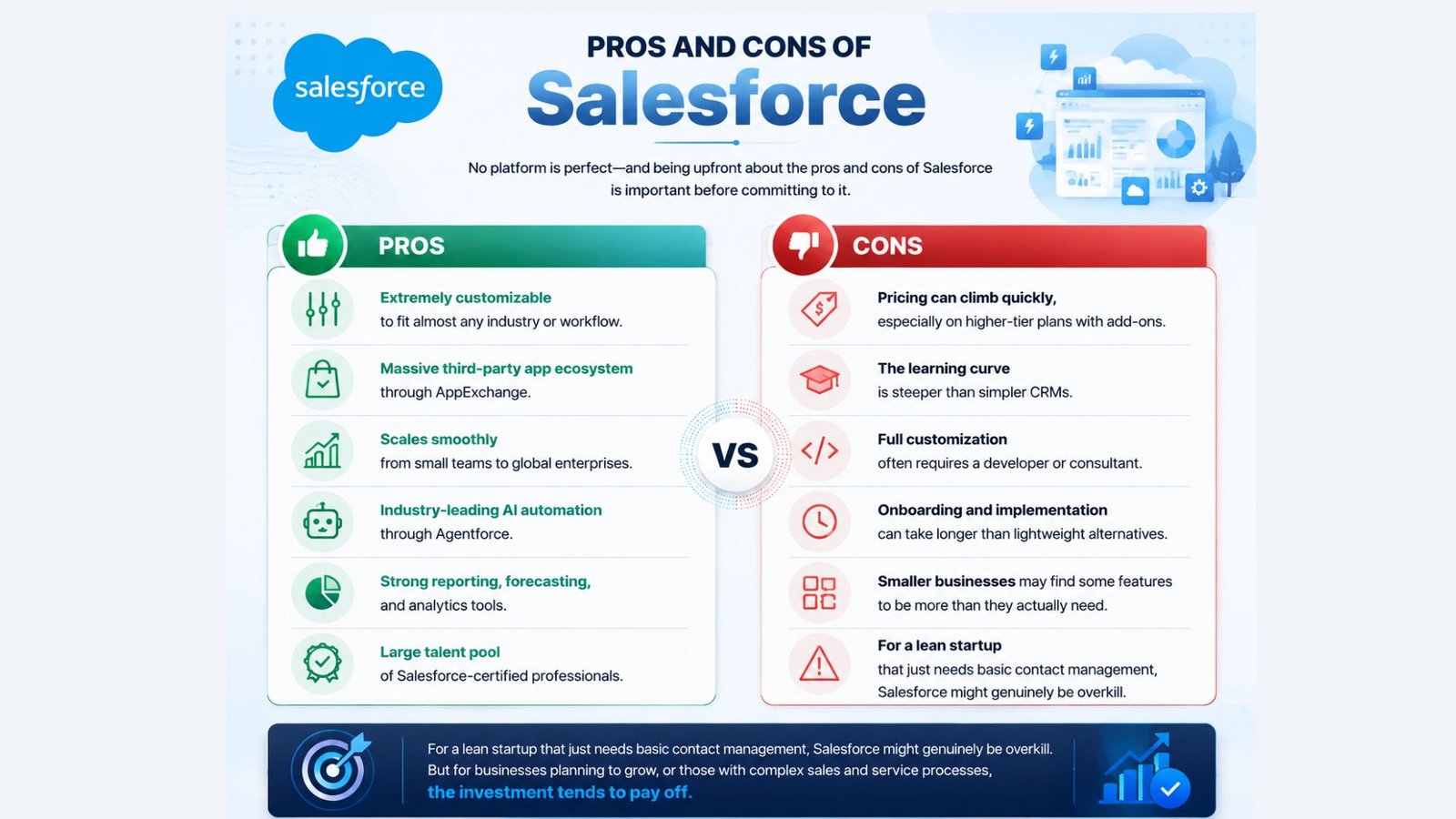
No platform is perfect and being upfront about the pros and cons of Salesforce is important before committing to it.
There’s no shortage of options in terms of CRMs — HubSpot, Zoho, Pipedrive, Microsoft Dynamics and more all have their strengths. So why use Salesforce specifically?
The honest answer is that Salesforce tends to win when a business needs depth and flexibility that lighter CRMs simply weren’t built to provide. If your sales process is straightforward and your team is small, a simpler tool might get the job done for less money. But as you move into complex sales cycles, multiple departments sharing data or industry-specific compliance requirements, the customization and ecosystem of Salesforce starts to make the cost and complexity worthwhile.
It’s also a question of longevity. Salesforce is not a platform that’s likely to disappear or be acquired and shut down – it’s the market leader, supported by continued investment in AI, data infrastructure and new product lines. Choosing a CRM is a long-term decision, and betting on the platform with the most staying power means less risk of another disruptive migration a few years down the line.
Successfully implementing Salesforce CRM isn’t just a matter of signing up and importing a spreadsheet of contacts. A good implementation often includes:
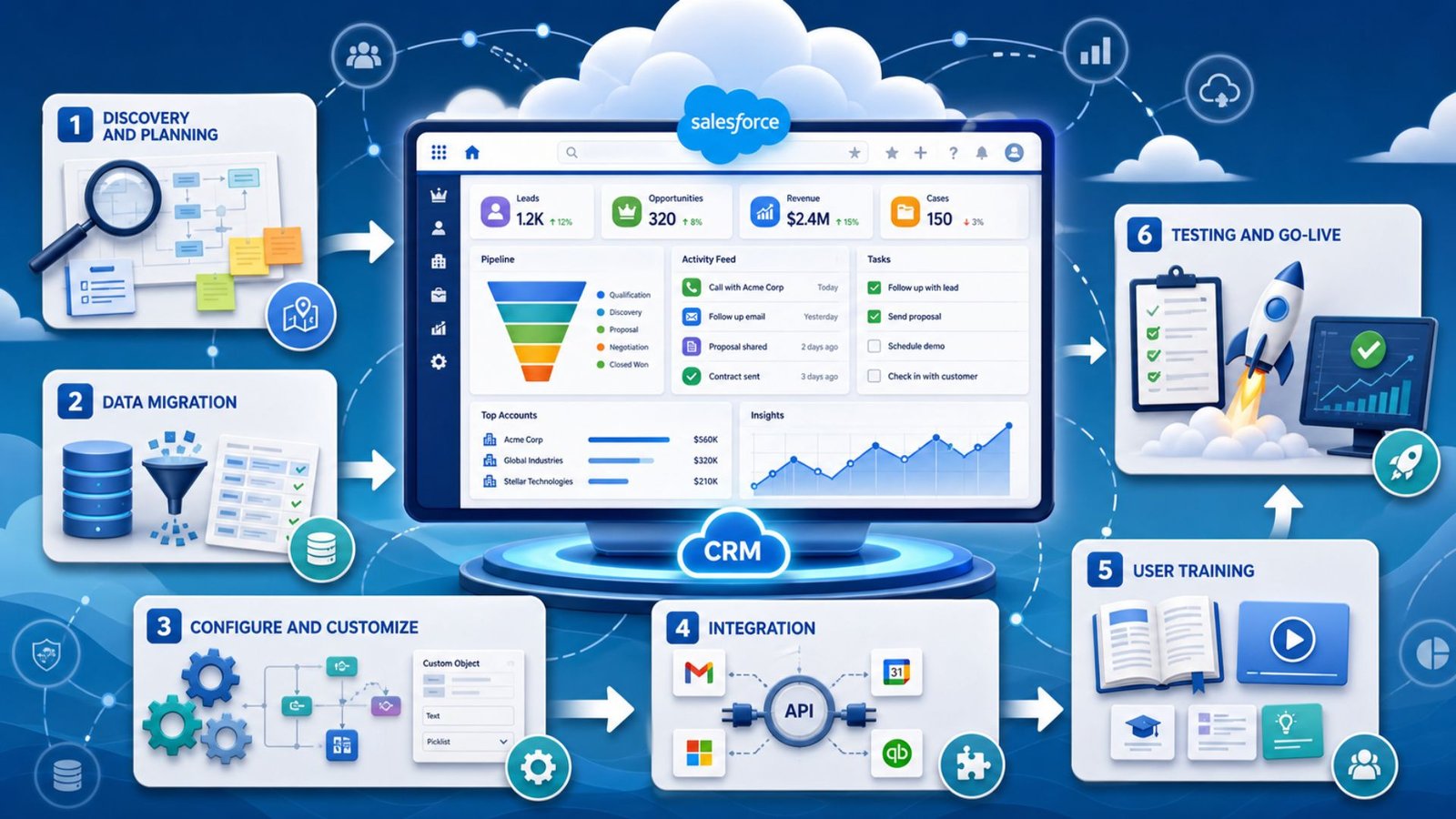
Skipping any of these steps is one of the most common reasons Salesforce implementations do not meet expectations. Uncleaned data before migration can lead to a cluttered CRM from the start, and neglecting user training will nearly always lead to low adoption regardless of how powerful the platform may be.
Not every company has the internal resources needed to install, maintain, and continually improve a platform as robust as Salesforce – that’s where managed services Salesforce providers can be beneficial. These are specialized teams or agencies that handle ongoing administration, custom development, integration maintenance, and system optimization on an ongoing basis, rather than as a one-time implementation project.
The ideal candidates for managed services are organizations that:
Utilizing managed services doesn’t mean giving up control of your CRM — it means having experienced hands on deck to keep the system running, address problems right away, and make sure you’re truly getting the full value of all that Salesforce has to offer.
Salesforce didn’t become the world’s most popular CRM by accident. It’s blend of deep customization, vast app ecosystem, enterprise-grade scalability, and true AI automation with Agentforce puts it in a class of its own. That said, it’s not automatically the right fit for every business – the cost and complexity are real considerations, particularly for smaller teams with simple needs. But for growing businesses, especially those that expect to scale, or manage complex customer relationships, or lean into AI-driven automation over the next few years, it’s hard to find a platform that can match what Salesforce brings to the table. Whether you’re just starting to explore implementing Salesforce CRM on your own, or considering bringing in managed services Salesforce experts to guide the process, understanding both the strengths and the tradeoffs will help you make a decision that actually fits your business – not just the hype.